

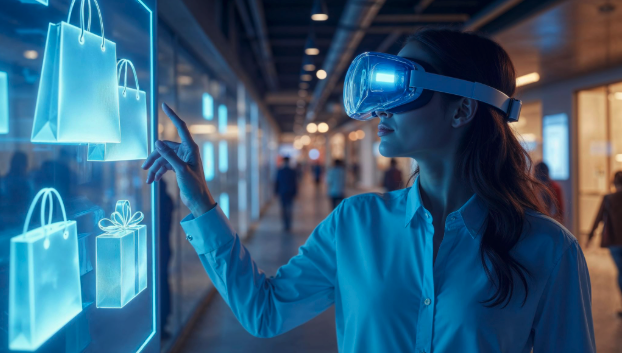
Integrating AR/VR into E-Commerce for Enhanced User Experiences
Over the past 20 years, e-commerce has become one of the most widely used shopping methods. As it enables easier and more efficient access to product information, it serves as an alternative to physically visiting stores, saving customers significant time and energy. However, modern society's fast-paced lifestyle, along with the growing need for complete satisfaction in the purchasing process, has made the traditional online shopping experience insufficient. It was no longer enough for customers to see clothing on a model or furniture in a setting that didn’t resemble their home. This led to AR/VR e-commerce, which introduced a virtual, more personalized, and immersive shopping process.
What are AR and VR?
Both of these models involve technology that in some way affects the physical world in which their users are located. The key difference lies in whether the user is entering the digital world or the digital world is superimposed into the real one.
VR or virtual reality is the creation of a computer-generated simulation of an entirely fictional realm that users can access and interact with using VR headsets, sensors, and gloves.
AR or augmented reality refers to technology that can project digital images or videos into the real world.
How AR and VR Work in Online Shopping
Augmented Reality (AR)
In the context of shopping, AR technology enables virtual product try-ons, allowing customers to preview products before committing to a purchase. Customers can point their phone at a mirror while standing in front of one, after which the clothing they selected appears on the screen as if they were already wearing it. This creates an experience similar to a fitting room, but in a virtual environment.
For this to work, the phone first needs to understand the space the customer is in. It first captures data about the room, lighting, surfaces, and the customer’s movements. Then it performs environmental mapping, analyzing dimensions, followed by product visualization, where the product is placed into the analyzed space.
Virtual Reality (VR)
VR takes it a step further by allowing customers to enter a fully virtual store where they can walk around and browse as if they were in a physical shop. From the moment customers put on a VR headset, they can fully interact with the items they see in the store and, after making a decision, complete the purchase of their desired products. Therefore, unlike AR, which can only partially display a product, VR does it in a much more complete and realistic way.
Real-World AR and VR Brand Examples
Some popular examples of brands using AR technology in retail include Adidas, Home Depot, and IKEA. Adidas offers the option of virtually trying on footwear. Home Depot allows customers to test different wall colors within their existing space, whereas IKEA shows how a certain piece of furniture would look in the room they intend to place it in.
IKEA also uses VR technology, where customers can walk through a furniture showroom in a simulated environment and try interactive product demos. Tommy Hilfiger also offers a virtual store, while Merrell and The North Face even provide the option of trying on hiking shoes within a simulated hiking experience. Alibaba has created an entire virtual shopping mall, while H&M features a virtual assistant that can serve as a personal shopping aid.
AR/VR and Community Interaction
AR and VR bring new ways for people to connect. One way is by organizing virtual events, such as the opening of new stores or the presentation of new brand collections. By doing so, people from all around the world can simultaneously attend and participate in the same virtual activities. Additionally, it enables users to shop together by entering the Metaverse as a group. This way, even long-distance online friends can hang out.
AR/VR Benefits
Users can access the necessary information more simply and comprehensively, which makes their purchasing decisions more confident due to reduced uncertainty. They can compare products faster and have a more enjoyable experience, which saves them a lot of time and overall makes the whole experience better.
Companies can save money in the long term because these features help reduce return rates, as customers make more informed and assured decisions. This practice can also lead to higher conversion rates.
Challenges That Come With AR and VR
This technology’s implementation costs are high, which is why not all companies will necessarily switch immediately to this sales method. Accessibility for users is limited as well because the number of people who can afford all the necessary technical equipment is still relatively small. Users may also have significant concerns regarding the privacy and security of their data, which may discourage adoption rather than encourage it.
AR and VR: Between Promise and Reality
There are many ways this technology could be used to engage communities, and while it often seems that it distances people, innovations like this may still bring them closer and make the whole experience meaningful.
Although it could grow beyond just a passing trend, it is still a fact that there is a significant digital divide, which can prevent it from becoming widely adopted. However, it is truly fascinating to observe its development and the growing interest around it, and assess whether this trend will achieve long-term adoption. For now, we can only observe its progress, try it if possible, and see where it leads.
Related posts:

.jpg)

ClickMind is a brand of ClickMind AG, Chamerstrasse 172, 6300 Zug, Switzerland (European Union).
USA operations: CLICKMIND INC., 8 The Green, Ste 20521, Dover, DE 19901, USA
United Arab Emirates operations: Green Modular Trading LLC, The Citadel Tower, Marasi Drive, Business Bay, Dubai, UAE
